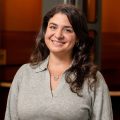
As a little girl Nikoo Yahyazadeh searched for herself in picture books but she never found anyone who looked like her, spoke like her, or carried her memories of Tehran in the pages.
Born in Iran and forced to flee with her family during the Iran-Iraq War in the late 1980s, Yahyazadeh, 40, arrived in the United States as a toddler. Now living in the Richmond Annex and raising a daughter, Yahyazadeh turned an absence she once found on bookshelves and turned it into a story that fills that gap for others.
Her first book, “Yasi and Mina’s Pomegranate Tree,” published by Sleeping Bear Press, tells the story of two best friends growing up in Tehran, whose lives are disrupted by the looming presence of war. While the narrative is fictional, it reflects the real-life experience of millions. Yahyazadeh hopes it resonates with any child who has had to leave any home, say goodbye to a friend, or make sense of change that’s out of their control.
“I think we sometimes underestimate what children can understand and what kind of topics that they can handle. And I think we particularly avoid topics such as war, displacement or immigration,” Yahyazadeh told Richmondside. “But I think that children can totally understand these topics and absorb these topics if they’re presented in an age-appropriate way.”
Sitting in her backyard, Yahyazadeh shared that she left Tehran at a much younger age than her book’s main characters.
Meet Your Neighbor: Richmond Author
Who: Nikoo Yahyazadeh
Neighborhood: Richmond Annex
Resident for: 3.5 years (Bay Area: 6.5 years)
She said: “My goal is to reach any child, really, who has maybe had to flee or leave like a war-torn situation, or has been impacted by conflicts in their own country,” Yahyazadeh said. “I’m hoping that they can see themselves in the book.”
Meet the author: There will be a book signing and reading at Jenny K. Gifts on Oct. 26 at 3 p.m., 6921 Stockton Ave, El Cerrito.
Richmond is home to 40+ distinct neighborhoods, a fact that some residents have told us makes them feel disconnected to the city as a whole. This story is part of an occasional series to help Richmonders get to know their neighborhoods. Know someone we should feature? Email hello@richmondside.org.
Her family first arrived on the East Coast. She attended grade school in central Pennsylvania and Florida, “where I was the only person with Black hair,” she said. Her high school years were spent in Washington, D.C., and after working there for a few years, Yahyazadeh moved to Richmond and had her daughter.
In the book, Yasi leaves Iran at around age 6. While the character is upset to leave, she also understands this is a privilege, especially because others like Mina can’t.
“I try to present it in a way that she realizes that she’s actually lucky to be leaving, and that not everybody has that opportunity. So that’s something that she’s kind of juggling with her friend,” Yahyazadeh said.
Flipping through the pages, illustrated by Armenian-Iranian artist Serineh Eliasian, the reader learns of significant cultural practices set to a beautiful backdrop of Iran’s capital city. When Yasi and her family are leaving Tehran, for example, Mina’s mom holds a bowl of water, a nod to an Iranian tradition of tossing water behind the car to basically bid someone farewell and safe travels.
“That’s like very insider information,” Yahyazadeh laughed as she flipped through the book. “The illustrations really bring the story to life but there’s a lot of storytelling happening through the illustrations that’s not in the text, which I think any good picture book does.”
Yahyazadeh said Yasi’s father even looks like her father, which was a pleasant surprise because the artist hadn’t seen pictures of Yahyazadeh’s family.

How Richmond and Iran are not so different
At face value, the book is a light-hearted read for primary school students who are interested in learning about different cultures and the world around them.
But on a deeper level, it explores how people are sometimes dealt a different hand in life — oftentimes at no fault of their own.
“Things like where you’re born, the opportunities that you have, what privileges you’re granted,” Yahyazadeh said. “And I think if a child is growing up in a war-torn situation, that’s even more apparent.”

She emphasized that the struggles of people in countries torn apart by war, especially in the Middle East, are often dismissed by Americans because conflict in the region is either normalized or overlooked. But the reality is, the struggles in Iran, Palestine or even Richmond are much more interconnected than one may realize.
So it’s important to humanize these stories, particularly for children so young, she said.
“Because if we don’t, then it just appears as a bunch of statistics, a bunch of numbers, and it seems like, ‘Oh, this is happening in a far off, distant land, and it has nothing to do with me and I’m not connected to it,’ when in fact, we’re all connected to it,” Yahyazadeh said.
Yahyazadeh illustrated the connections between here and there in many ways.
For one, Richmond is home to an active Iranian community. Earlier this year, the city sponsored its first public celebration of Nowruz (Persian New Year), with hundreds of people attending. SF State’s Center for Iranian Diaspora Studies, which cohosted Nowruz, also held a number of other events in the city.

Richmond City Council member Soheila Bana is Iranian American, and in June the council approved an emergency resolution calling for diplomacy and an end to hostilities between Israel and Iran following the Israeli military strike on Iranian territory.
Yahyazadeh said Richmond’s celebration of its diversity is one aspect that quickly made the city feel like home — and a place she wants to stay long term.
Richmond is also home to a significant refugee and immigrant population, with nearly 1- of- 3 residents reporting being foreign born, according to the city.
Many Richmonders could likely relate to Yahyazadeh’s experience, leaving violent situations in countries such as El Salvador, Mexico, Yemen and elsewhere, she said.
Mina’s experience, hiding in her home because of war, might resonate with undocumented immigrants who are living in fear of increased ICE raids. And just like there are starving children in Gaza, there are children here who do not have enough food on their plate, Yahyazadeh said.

“My goal is to reach any child, really, who has maybe had to flee or leave like a war-torn situation, or has been impacted by conflicts in their own country,” Yahyazadeh said. “I’m hoping that they can see themselves in the book.
“And if they’ve been through such a situation, they can understand that although maybe you’re leaving your home, it doesn’t necessarily mean that it doesn’t exist within you, and that home can be something that you carry, no matter where you’re going or what you’re going through,” Yahyazadeh continued. “And how to navigate friendships when someone has to move.”
The book received an honor in 2022 that came with a stipend and editorial support, which led its publication as part of the publisher’s “Own Voices, Own Stories” collection, a landing space for new authors from historically marginalized communities. She is also co-ambassador for the Authors Guild Bay Area, where she helps put on events for similar authors.
For Yahyazadeh, it was the perfect place for her story — one inspired by the absence she once felt as a child reader.
“We are so lucky that now there is more representation,” Yahyazadeh said. “Growing up, I didn’t really see any picture books like that, but now there’s such a big movement around our own voices and our own stories.”
Those interested in listening or purchasing “Yasi and Mina’s Pomegranate Tree,” Yahyazadeh will be doing a reading and book signing on Oct. 26 at 3 p.m. and Jenny K Gifts, 6921 Stockton Ave, El Cerrito, CA 94530.