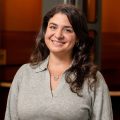
Almost whatever a Contra Costa Community College student could possibly need can now be found in one place: The school’s newly relocated Compass Center.
It’s a place to charge your phone, pick up some donated clothes or grab groceries for the week — a one-stop shop where students can access resources for free.
“This basic needs center, I am so glad it’s here. It’s foundational. This is only the start,” said Hope Dixon, who leads and founded the center. “We did it, but we are not done.”
Opening this space has been years in the making. The center, as a concept, opened in 2023 with a tiny food pantry shelf and resources including transportation vouchers, mental health care information and many more. But Dixon was offering a lot of this support from her small office while students had to visit places on campus to find what they needed.
Now it’s all in one place, at the Student and Administration building in room 120. There’s a walk-in food pantry, donated clothes, a coffee stand, school supplies, a lactation pod and even parent-friendly desks that have a playpen connected to the desk. The college held a soft opening over the summer to prepare for the fall semester.

“We also got a ton of beanbags because students like those,” Dixon said. “And this space transforms into whatever you want it to be.”
There are several desks that can be fitted together to create a big conference table and a projector that can be used for community meetings or movie nights. In the corner is Dixon’s new office.
Dixon envisions it being used as a multi-dimensional space where a student can quickly stop by for a bite or meeting, or hangout and study. She also wants it to be a hub for local community organizations to collaborate and advocate for more resources for the community at large — particularly housing.

“But it’s not easy to get these things on our own,” Dixon said. “We’re going to continue collaboration (with cities, the county and other organizations) to bring our big visions to reality.”
Community colleges were required by the state to open basic needs centers. Guided by legislation, the state allocates funding each year ($30 million statewide) to operate such campus centers and food pantries.
It helps close a major gap. About 46% of California community college students experience food insecurity, and yet more than 70% of those who are eligible do not receive state food benefits such as CalFresh due to application hurdles or eligibility confusion.

Last year, Gov. Gavin Newsom signed AB 271, expanding the legal definition of basic needs to explicitly include childcare services, requiring campus child development programs or preschools to directly connect student parents to the needs centers and financial aid. The food pantry is also open to staff members who need food.
Dixon hopes the state will eventually provide student housing at community colleges, something that she sees as a particular need. About 1-in-every-5 students at the community college have experienced homelessness. In Contra Costa County, there are an estimated 2,600 homeless children and youth experiencing homelessness.

Last year, the compass center served about 60 to 80 students a day. It also provided more than 6,100 lunches and 1,700 breakfast meals that students could pick up from food lockers. Dixon believes the current demand is much higher.
“I’m a first generation student myself, and college changed my life. I was going to drop out of college, and the interim dean changed my life by offering me an emergency wraparound grant,” Dixon said. “Now I am able to pay it forward.”
Even before it moved to its new location, the Compass Center had an outsized impact. It has helped several homeless students find a place to live, such as Teddy Thollaug, who works for Dixon.
Students say being homeless while in school is much harder than one might think
Thollaug is a third-year student studying art and journalism. She got the gig by chance.
“During the start of the year I actually was homeless. I ended up going to (Dixon) for assistance,” Thollaug said. “She showed me the ropes and then told me, ‘By the way, I have a job opening,’ and she hired me when no one else would take a chance.”
Thollaug said being homeless and going to school is so much harder than people could imagine. She fell into financial trouble when her guardian passed away, leaving her providing for herself. As a high school student in the Richmond/El Cerrito area there were more resources, but after graduating from WCCUSD’s adult school in 2024, she was stuck in a grey zone without help.

She met Dixon while living in a county shelter for young people. With the student job and help navigating financial aid resources, Thollaug eventually saved enough money to move into subsidized housing nearby and buy her own car. To make ends meet, she also works another job at the Youth Action Board of Contra Costa County and collects Social Security.
But in that year of living in a shelter, Thollaug still had to find a way to pay her phone bill, get medical care for a disability and find transportation to and from the shelter in Richmond — all while trying to find enough healthy food to last through each week.
“For us, this is more than community. This is a lifeline. This is a future for young people.”
Leon Saelee, a formerly homeless Contra Costa College student who found help at the college’s basic needs center
Thollaug said the shelter did provide some transportation and food, but the program was inflexible. She struggled to meet their 5 p.m. curfew and still finish her studies. She also said the food was at the least not tasty, and at the worst, gave many residents food poisoning.
“So this place is just transformational,” Thollaug said. “At the very least it’s just somewhere to exist because I couldn’t be anywhere. I couldn’t be at the shelter for the entire day.”

Leon Saelee was also experiencing homelessness while studying at Contra Costa Community College. He became a student worker under Dixon and helped students like himself get the help they needed.
His experience led him to become the president of the Youth Action Board, a group that helps youths and young adults from age 16 to 27 who have been homeless advocate for the changes in the county’s homeless care system.
Saelee is now moving to Los Angeles to work for a nonprofit.
“For us, this is more than community. This is a lifeline. This is a future for young people,” Saelee told Richmondside. “It’s not the end of all the problems, but I think there’s a lot to work with, and now that we’re at this great milestone … we’re able to feed and support families, guide young people to better education and start the groundwork to bring in more resources like housing development for students, families and staff.”