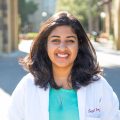
A Richmond science teacher is getting her students excited about learning with what some might see as an unconventional hands-on project: They’re submitting their genetics for DNA testing.
Participating Leadership Public Schools (LPS) high school students had to get permission slips signed, then swabbed their cheeks and sent off their DNA kits to Ancestry.
Months later, the students got their ancestry results, some of which were unexpected.
“ I found out that I am part Jewish and 6.7% African and I never would’ve expected that,” said Ximena Gutierrez, a former student in the class. Gutierrez signed up for “Ms. B’s,” (Devyvani Bhadkamkar’s), AP Biology class even though she never intends to pursue a science career.
“ A lot of us took AP bio because we know Ms. B’s a good teacher,” she said. “And I think when a teacher likes her job, it’s really obvious,” Gutierrez said.

Bhadkamkar, a Palo Alto native, arrived at Leadership Public Schools through Teach for America in 2019. Since then, she’s developed a reputation for organizing cool projects.
Gutierrez said that she found new cousins on 23andMe, and one has even reached out to her online.
Ruby Rodriguez, a senior at LPS who took the class in 2024, learned she had Spanish and Portuguese heritage. That was unexpected because, for her whole life, Rodriguez thought, “I’m just Mexican.” She shared the results with her mom, who also became interested in completing the sequencing kit.
Gutierrez, who also found out she had Spanish and Portuguese ancestry, said. “ I think a lot of us shared similar DNA because we all got colonized by similar people.”
Both Gutierrez and Rodriguez say using kits such as 23andMe, and later Ancestry.com, helped them contextualize the course material and understand real-life implications.

Completing the kits is “something that when people take AP bio, it’s something that they look forward to,” said Gutierrez.
Students also learn about possible consequences of DNA testing
Bhadkamkar is especially careful to explain to students — and parents — the potential consequences of completing a DNA kit. She discussed the possibility of finding new siblings and other family members.
She also discussed what sequencing companies may do with the students’ genetic information. For example, personal genetic information can be de-identified and used for research. She reminded parents that they can delete their child’s information off of the company’s websites.
Bhadkamkar reflected on her own genetic sequencing results. She found out that she’s 25% Jewish, 25% French and 50% Indian.
“I think being brown is such a vast expanse,” said Bhadkamkar, explaining that it struck her that it was easier to trace her European side to a particular subgroup while the origins of her Indian side were far less specific.

“It’s an interesting discussion about getting more diversity in the research sets” and balancing potential trade-offs, said Bhadkamkar.
The trade-offs? Data privacy. Ultimately, it comes down to “do you trust the organization with your DNA,” asked Bhadkamkar.
Bhadkamkar’s own educational heritage is impressive. Growing up in Palo Alto, Bhadkamkar attended Gunn High School and later Stanford University. Interested in science, she dabbled in research, tutoring, and the start-up world during college.
“I appreciate learning the techniques, but [working at the start-up] just didn’t align with my values,” said Bhadkamkar.
While her time in the Palo Alto “bubble” gave her strong science skills, “it was not very grounded,” said Bhadkamkar. For two years after graduation, Bhadkamkar worked in different educational roles, making sure teaching was the right profession for her.
She took the plunge with Teach For America and was placed at LPS, a charter school, in Richmond in 2019. She has taught various levels of chemistry and biology since.
In her time at LPS, many funding questions have come to the forefront of Richmond’s education community. Bhadkamkar said this points to a larger issue of education funding.
“”
“My role is to create choice and opportunity for my students to decide what’s best for them.”
— Devyvani Bhadkamkar, AP science teacher, Leadership Public Schools
“How do we have so much money in the bay? And then we’re pinching pennies when we talk about education,” she said.
For example, when Bhadkamkar planned this genetic sequencing project, she decided to fundraise for it on GoFundMe rather than add to the school’s already-burdened budget.
“I didn’t want to add more to their plate,” Bhadkamkar said.
Many teachers report paying for supplies out-of-pocket. In 2022, the IRS estimates that more than 3.6 million tax returns claimed $300 of educator expenses.
Gutierrez said Bhadkamkar is unique in that “when she has an idea for something she like goes out of her way to execute it to its entirety.”

Bhadkamkar’s impact on her students is undeniable. Many students still keep in touch with her after graduating.
“One of my biggest wins is actually after students graduate and I get to hear from them [and] just learn about their lives after high school,” said Bhadkamkar.
One such example is Gutierrez, who is now a freshman at Santa Clara University. She still keeps in touch with Bhadkamkar, visiting when she is in town.
Gutierrez is studying accounting, hoping it will help her get a financially stable job after college. Bhadkamkar supports Gutierrez’s decision.
“My role is to create choice and opportunity for my students to decide what’s best for them,” said Bhadkamkar.
She says she achieves this by giving students the technical skills they need to navigate the system and by creating spaces where students can wrestle with complicated topics.
Despite her family pressuring her to return to Palo Alto, Bhadkamkar plans to keep teaching in Richmond. She hopes to keep growing as an educator and find new ways of inspiring her students.
“I don’t see myself going back,” said Bhadkamkar, “I’m pretty connected or attached to the Richmond community.”
This story was updated to correct Bhadkamkar’s DNA results.