“Jaime, lucha por los trabajadores.”
“Jaime, fight for the workers.” Those were the words my grandfather, a blacksmith in Puerto Cortes, Honduras, gave to my father as a directive that would shape his life. My late father, Jaime Aguilar Smith, carried those words with him as he built his career as a labor law attorney. For decades, he stood shoulder-to-shoulder with workers, ensuring their rights were defended against powerful interests. His life embodied the belief that labor is not just about wages or contracts, but about dignity, solidarity, and justice.
This Labor Day, I found myself far from Puerto Cortes but deeply reminded of my family’s legacy. I attended the Bay Over Billionaires #WorkersOverBillionaires rally in Richmond, a city with its own proud labor history and ongoing struggles for justice.
There, I witnessed active and retired union leaders standing side-by-side, demonstrating the full arc of union leadership. I also listened to elected officials including Richmond City Council member Claudia Jimenez and council member Doria Robinson, and community advocates such as Carmen Martinez, chair of the Community Police Review Commission and a staunch immigrant rights leader. And perhaps most moving of all, Richmond high school students took the microphone, reminding us that the future of the labor movement is already here.
Together, their voices carried the same message my grandfather once gave my father: Workers must be defended, and their fight is everyone’s fight.
Richmond and Puerto Cortes: Port cities, refinery cities

On the surface, Puerto Cortes, Honduras, and Richmond, CA,, may appear worlds apart. But both are port cities shaped by the power — and the consequences — of oil refineries. Puerto Cortes had Texaco; Richmond has Chevron. The link between them is not only symbolic: Chevron acquired Texaco in 2001, making their corporate legacies one and the same.
My father knew Texaco’s reach intimately. He was at the center of a five-year class action lawsuit against the company on behalf of Honduran refinery workers, a legal battle he later chronicled in his book: “Los trabajadores contra la refinería Texaco de Honduras: cinco años de combate legal.” For him, litigation was not only about legal briefs and courtrooms; it was about giving voice to workers who otherwise would have been silenced.
In Richmond, the Chevron refinery has long been a flashpoint for labor, environmental, and community justice struggles. As former Mayor Gayle McLaughlin chronicled in her book “Winning Richmond,” the fight against Chevron’s outsized power has shaped the city’s identity and politics for decades. Standing at the Labor Day rally, I felt the throughline from Puerto Cortes to Richmond: Port cities where working-class people have had to fight for fairness in the shadow of corporate giants.
A legacy continued
My father’s devotion to workers did not stop with him. Today, my nephew Isaac Velez is a second-year law student at Duke, carrying forward our family’s tradition of legal-based advocacy. This summer, he worked as a Peggy Browning Fellow in the General Counsel’s Office of the Laborers’ International Union of North America Eastern Region, representing more than 45,000 workers across New Jersey, New York City, Delaware, and Puerto Rico.
Though he is still finding his footing as a young lawyer-in-training, his experience — much like my father’s early years — is already shaping his sense of purpose. Seeing him step into this role makes clear that my grandfather’s words are still alive, still guiding us across generations and geographies.
Sociology, solidarity and Coach Carter
As a sociologist, I see labor not only as contracts and disputes but as a lens into how communities survive, resist, and thrive. Labor struggles reveal who holds power and who is excluded from it. They show how dignity is negotiated, sometimes against impossible odds.
When I think of Richmond, I cannot help but recall the film “Coach Carter,” based on the real-life story of Richmond High School’s basketball coach who famously benched his undefeated team because players were failing their classes. That story has stayed with me because it is about accountability, discipline, and the belief that young people can transcend adversity if given the right framework of support and expectation.
In many ways, labor advocacy carries the same spirit. Workers are often told to accept less — less pay, less safety, less respect. Yet, like Carter’s students, they show us what is possible when communities rally together and insist on fairness. Richmond’s history, and the spirit I felt at the Labor Day rally, is a testament to this kind of resilience.
Palante, siempre palante — Forward, always forward

Labor Day may be behind us, but the struggle for worker justice is never confined to a single day. From Puerto Cortés to Richmond, from my grandfather’s forge to my father’s courtroom, from Texaco’s refinery to Chevron’s, from union halls in New Jersey to high school gyms in Richmond, the fight continues.
The voices I heard in Richmond — council members Claudia Jimenez and Doria Robinson and police reform activist Carmen Martinez, active and retired union leaders, and high school students — are part of the same chorus my grandfather once began. They remind us that solidarity is not abstract; it is lived in the daily choices we make to stand with workers over billionaires, with communities over corporations, and with justice over indifference.
My family’s story is one thread in a much larger tapestry. But it is one that reminds me of my responsibility — as a son, an uncle, a sociologist, and a community member — to carry the legacy forward.
Palante, siempre palante.
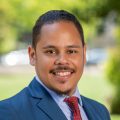
Hansel Alejandro Aguilar, PhD, the city of Berkeley’s Director of Police Accountability, is a sociologist originally from Puerto Cortés, Honduras, who — by way of New Jersey and Virginia — is now living in the East Bay. His research focuses on migration, transnationalism, and human rights.