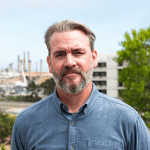
When the Martinez Refining Company exploded into flames on the morning of Feb. 1, Justin Gomez tried to distract his two kids, ages 6 and 8, from looking out the window as he watched a plume of black smoke grow in the sky above.
Even before the fire started, the Bay Area Air District (formerly called the Bay Area Air Quality Management District) had received multiple reports from people in the area complaining of a foul oily smell emanating from the refinery. By 2 p.m. a large uncontrolled fire was burning in a part of the refinery that processes light oil, and there flaring, the intentional burning of excess gases.
It was around this time when Gomez and his wife received an alert from the county’s Community Warning System, saying that the fire could affect the health of sensitive populations. The county later upgraded its warning, encouraging people to shelter-in-place.
Gomez, as a member of Healthy Martinez — a community group advocating for local refinery accountability — is more familiar than most with the health risks associated with oil refining. The couple decided to get their kids out of the house and leave the area entirely.
What’s fueling Richmond’s air pollution?
This article is part of a series investigating the causes, impacts, and possible solutions to local air pollution. See the full series.
This reporting was supported with funding from the Data-Driven Reporting Project and the Fund for Investigative Journalism. Read our nonprofit’s policy on editorial independence.
“We don’t know what’s going to happen. Our kids are freaking out. This feels unsafe. Common sense would dictate we just drive away from this,” Gomez recalled thinking, a week after the fire. “We don’t need to be in any close proximity in case something escalates.”
By 5 p.m., the city’s warning sirens were going off every 30 minutes, as crews tried to contain the fire. MRC later confirmed that the plumes contained combustion byproducts that can cause cancer, heart and lung disease. It took more than three days for the fire to be put out and for the county to lift its health advisory.
Dr. Ori Tzvieli, Contra Costa county’s health officer, said that wind blew most of the toxic smoke north to unpopulated wetlands and the release of chemicals “could have been much worse.”
“We got lucky this time,” Tzvieli said in a statement. “But our community shouldn’t have to rely on luck.”
But residents like Gomez don’t feel so lucky. February’s fire was one of several significant refinery-related incidents in recent years impacting people in Martinez, which is home to two of Contra Costa County’s four fuel refineries, MRC and Marathon. The MRC refinery, which is owned by PBF Energy, is the second largest refinery in the Bay Area, behind only Chevron’s Richmond location.
Like in other Bay Area refinery towns, some Martinez residents have grown weary of the official statements that come from their corporate neighbors following major accidents, and even the notifications from the county, which relies on information self-reported by refineries.
“We don’t trust the information we’re getting. There’s just so much fear that exists in Martinez,” Gomez said.
He added that Martinez hasn’t seen anything as bad as the 2012 Chevron Richmond fire that sent thousands of people to hospitals, mostly for respiratory concerns. “We haven’t crossed that threshold yet, but it felt like that could have happened,” Gomez said. “That’s the specter of what we all are still living under.”
The catastrophic 2012 fire brought calls for stronger refinery regulations and a greater sense of urgency to environmental activism in Richmond. That urgency was reflected in the 2014 local election, when residents voted in a slate of progressive officials to lead the city, despite Chevron spending several million in support of candidates more in line with the company’s interests. A decade later, Richmond officials negotiated a $550M settlement with Chevron in exchange for removing a refinery tax measure from the November 2024 ballot.

As a result of these events and others, Gomez said he and other environmental activists in Martinez have increasingly looked to Richmond as a model of what a refinery town can accomplish with an engaged citizenry.
“We’re looking at Richmond, and the playbook of a lot of the groups that you all have out there,” Gomez said.
Like in Richmond, there is no one living in Martinez today who remembers the city before oil refining. The first refinery in Martinez was built in 1904 at Bull’s Head Point. Associated Oil Company, now Marathon, began in 1913. Shell Oil, now the MRC refinery, followed in 1915.
“We’re looking at Richmond, and the playbook of a lot of the groups that you all have out there”
Justin Gomez, Healthy Martinez
But Martinez differs from Richmond in at least one important way: The city’s two current refineries sit on unincorporated county land. As a result, regulating power lies outside of the city, with county, state and federal agencies.
“I feel like Richmond, you all are better positioned for the advocacy and the political pressure. I feel like the refinery being within your city limits has offered certain advantages,” Gomez said. “It’s been a learning curve for a lot of the community members here to understand the jurisdictional context and permitting and agencies at play.”
While the refinery “feels” like a part of the city to residents, he added, “a lot of folks really don’t understand that our city leadership has no legal authority over their operations, which has been a bummer.”
Gomez said it’s harder for groups like Healthy Martinez to move the needle with county and regional agencies that are a step removed from local residents’ concerns. “I think when we get to the county level, it’s like the political will is almost different given the economic driver” that oil refining is in Contra Costa County, he said.
Shanelle Scales-Preston, the newly elected District 5 county supervisor who represents Martinez, said in a statement shortly after the MRC fire that she understood “the frustration, fear, and anger experienced by Martinez residents.” She called it “not acceptable,” noting it was the “third major incident since PBF Energy purchased the refinery in 2020.” Scales-Preston said she plans to host a town hall to address residents’ concerns, but no date has been set.
Scales-Preston did not respond to a request from Richmondside for further comment.
Refinery accidents in Martinez have spurred community action

Healthy Martinez was formed in response to a series of refinery accidents at MRC that have occurred since PBF Energy bought “one of the most complex refineries in the United States” from Shell in 2020.
Prior to February’s fire, one of the most pronounced events at MRC involved the release of 24 tons of airborne catalyst powder — a substance used to speed up chemical reactions — into the community on Thanksgiving eve in 2022. Residents awoke the next morning to find their cars and homes covered in metallic dust. According to an independent report released last August, the accident was partly a result of inadequate training and employees working up to 25 hours at a time with only short breaks. Because the employees didn’t realize the refinery was releasing hazardous chemicals until hours later, the county’s warning system wasn’t used to alert residents.
In July 2023, Martinez residents again awoke to pollution from the refinery coating the city, only this time it was petroleum coke — a black oil refining byproduct linked to numerous health problems. Later that year, in November, the refinery reported visible flaring after receiving complaints from community members. That December, MRC reported an abrupt shutdown that led to flaring and a brush fire in the plant’s flare field, resulting in black smoke for about 13 minutes, releasing 14,000 pounds of sulfur dioxide.
Four lawsuits filed in November on behalf of residents blamed the events for causing health issues such as difficulty breathing, headaches, brain fog and itchy and burning eyes, as well as longer-lasting health effects. Other damages included having to discard outdoor gardens and diminishing property values.
A year after the Thanksgiving eve release, the Contra Costa County District Attorney’s Office announced in November 2023 it was forming “a joint civil enforcement action against the Martinez Refining Company” with regulators such as the Bay Area Air District, the U.S. Department of Fish and Wildlife, and Contra Costa Health. More recently, following the Feb. 1 fire, the DA’s office said in a statement that it’s still working collaboratively on “previous violations at this refinery,” but “the confidential nature of the process prevents us from commenting on the status of this enforcement action.”
Those events, along with the refinery annually emitting roughly 300 tons of PM 2.5 — fine particulate matter of great concern because of how it buries deep into the body — led residents like Gomez to organize under Healthy Martinez to demand action from MRC. The group issued a list of eight demands following the Feb. 1 fire, which include independent air monitoring, better communication between MRC and the community and reimbursements for damages.
Under Trump, a full federal investigation into the latest Martinez refinery appears unlikely
Also included in Healthy Martinez’s list of demands is an investigation by the U.S. Chemical Safety and Hazard Investigation Board (CSB), the independent federal regulator tasked with investigating chemical accidents at large industrial facilities, including oil refineries. CSB doesn’t punish companies with fines, but it does release detailed findings and make safety recommendations to those companies and regulatory agencies such as OSHA.
In Richmond, CSB’s investigation of the 2012 refinery fire at Chevron produced detailed reports and dozens of safety recommendations and helped to inform city council and other public meetings.
Rep. Mark DeSaulnier, who represents parts of Contra Costa County and previously served on the BAAQMD and the California Air Resources Board, said the CSB investigations and reports are important learning tools — not just for cities where facilities are being investigated, but others as well — since all of the West Coast refineries are intertwined in the same regional energy market.

“It’s just nice to have agencies that aren’t necessarily duplicative (with county or state),” said DeSaulnier, and that can act as “a second set of eyes that have a national perspective.”
In Martinez, CSB has investigated several incidents over the years at the current Marathon site: The most recent was a fire in November 2023. Another was a fire in 1999 (when it was known as the Tosco Avon refinery) that killed four workers, a tragedy investigators attributed to “flawed management and supervision.” And in February 2014, CSB pushed back against Tesoro (which owned the refinery at that time) when the company attempted to block its investigation of an acid spill.
The recent fire at MRC, however, is not currently on track to receive the same level of federal scrutiny.
Hillary Cohen, a CSB spokesperson, said in an email to Richmondside that the incident may not meet the requirements for a full-scale investigation. She said the agency is currently gathering information from the company to include in a much shorter volumized incident report. The first of such reports was published in January, containing two-page summaries of “accidental release events” at refineries and other facilities that resulted in death, injury or significant property damage.
The future of CSB is uncertain amid the Trump Administration’s efforts to cut funding for federal agencies, including those that regulate gas emissions.
The future of CSB is uncertain amid Trump Administration efforts to cut funding for federal agencies, including those that regulate gas emissions. Trump tried to shut down CSB during his first term and began his second by announcing it was time to “drill, baby, drill,” a reference to expanding domestic oil production.
Currently, there are two vacancies on the five-member investigative agency’s board, where members are appointed by the President and confirmed by the Senate to serve five-year terms. The three current members were all appointed by former President Joe Biden. Two of their terms expire in 2027 and the other in 2028.
While a full federal investigation of the Feb. 1 refinery fire is uncertain, regional air regulators have taken some action.
The Bay Area Air District issued three notices of violation to MRC, one each for creating a public nuisance, failing to operate equipment as permitted, and excessive smoke and soot fallout. They are among roughly 200 notices of violation issued to Martinez Refining Company by the air district that are currently “pending,” according to the air district’s website.
Chevron Richmond and MRC simultaneously settled in February 2024 for multiple violations of BAAQMD’s Rule 6-5, which the air district calls “the most health protective rule of its kind in the nation,” as it reduces particulate matter produced during the gasoline manufacturing process, the largest source of PM at these refineries. The oil companies had challenged the air district in court, eventually relenting. Chevron agreed to settle with fines up to $83 million over four years if it doesn’t meet the stricter standards by 2026, while MRC agreed to install a monitoring system to ensure compliance.
Chevron also agreed to pay $20 million into a community fund, and another $20 million to settle 678 additional violations. Chevron’s settlement would be the largest, to date, in BAAQMD history.
It’s those kinds of recurring events at oil refineries and subsequent settlements with regulators that have residents like Gomez angry and confused about the long-term health and environmental impacts of living not just in a refinery town, but in the only Bay Area city with two fuel refineries very close by.
“The cumulative effects of what we are constantly breathing in every time they flare, every time they release dust, or anytime something’s on fire, we still don’t know, and our county health officials can’t tell us,” he said. “To me, as a resident, that’s the part where I truly fear for my and my family’s health and safety, because there’s just this question mark around long-term, repeated exposure.”


We want to hear from you
Got a tip to share about environmental pollution in Richmond? Email us at hello@richmondside.org, leave us a voice message at (510) 239-7413, or use our tips form.
You can also let us know how you are personally experiencing local environmental issues by filling out our survey.