


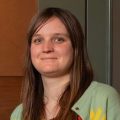
Shannon McCants sits down and takes a break from gardening at Unity Park in Richmond, watching with pride as her friends spread mulch on the ground.
McCants, 39, is here with VistAbility’s Commercial Support Services, a program for adults with intellectual and developmental disabilities. Through a partnership with the nonprofit Urban Tilth, the group volunteers at the garden every Tuesday.
McCants grew up in Richmond and loves it here, helping her community by picking up trash.
“People are nice,” she said. “They know we have a learning disability, but they’re still teaching us. I’m trying to learn stuff one-by-one. It’s all new to me.”
Volunteer events like this are one way of keeping the space clean and accessible, and empowering residents to connect with the land. But there can still be barriers to gardening, such as a lack of shade, accessible water fountains, restrooms, or space for people who use wheelchairs. Urban Tilth wants everyone to enjoy this green space, regardless of their abilities.
That’s why the nonprofit is transforming a vacant space at 17th Street along the greenway into the first universally accessible public garden in Richmond. Organizers unveiled the design for the accessible garden this summer, but only after gathering feedback from dozens of seniors, people with disabilities, families and caregivers. VistAbility was one of the groups consulted for the project.

Matt Hansen, program coordinator with VistAbility’s Commercial Support Services, said the group works with people who have cerebral palsy and those who use wheelchairs.
“Being out in nature is very therapeutic,” Hansen said. “And for individuals with developmental disabilities, there isn’t as much access to getting out in nature. So the opportunity for us to take a stake in helping revitalize the greenbelt has been wonderful.”
The plan for the space, expected to be complete before the end of the year, includes an accessible restroom and a drinking fountain with a dog bowl for those with service animals. There will also be a sensory garden and trees to buffer the wind. Seniors can sit in accessible benches, and people can roll up and park wheelchairs partially under specially designed plant beds.
Imagining a greenway for all
The recent effort to create a universally accessible garden is part of a decade-long push by advocates to transform the Richmond Greenway into a community hub where everyone can garden, gather, and play. The late activist Lillie Mae Jones had a vision beginning in the 1960s for turning the former Sante Fe rail line into the Richmond Greenway. She imagined a bicycle and pedestrian path filled with community gardens and benches.

Friends of the Richmond Greenway formed in 2006 to maintain the project, and in 2015 went door-to-door to gather input from neighbors on what they wanted to see from the space.
Arleide Santos, a community organizer with Urban Tilth, said keeping the space clean and free of trash is only the beginning.
“Once the space is clean, what else can we do? So we go back to the community,” Santos said. “We saw the needs of seniors who came to our special events, unable to work in the gardens.”
Santos remembered a conversation with a neighbor a few years ago during a Halloween event. The resident, who uses a wheelchair, said she loved seeing the community together, but wished she could work the flower beds.

“”I said, ‘Wow,’ ” Santos said. “If someone is not doing an activity today, it does not mean that they don’t want to do it.”
Santos recognized a need to make gardening more accessible for everyone in Richmond, and funding made that vision possible. The universal garden project is supported by the California Strategic Growth Council’s Transformative Climate Communities Program, which aims to empower communities to reduce greenhouse gas emissions and local air pollution.
Listening to the community
Residents mentioned wanting benches, and flower beds high enough for people to stand without having to bend so often. They asked for a restroom nearby, seating areas for workshops, a mural, and water fountains for both people and dogs. A participant who is blind said he loves to be outdoors and wants a garden that draws in birds.
With the funding to support this work, Urban Tilth set out to listen to the community. The group connected with more than 80 seniors, people with disabilities, families, and caregivers on what they wanted from a garden. They conducted surveys and asked questions including, “What does an accessible garden look like to you?” and “What type of beds would be ideal?”

With the feedback in mind, Marcia Vallier, a senior landscape architect with CSW|ST2, got to work.
As part of the design, the beds are laid out to be a kind of labyrinth for people to have a meditative path through the central core. The garden also includes a circular, fenced area where people can walk around.
Spaces are designated for composting, and there is a vegetable washing station and a linear table with circular cutouts where people can smell and taste different herbs. The benches will have backsides and middle arm rests for seniors, who can use the arm rests for support as they sit down and get back up.
Artists with NIAD Art Center, a nonprofit in Richmond that supports artists with disabilities, were among those consulted for the garden design. Shantanice Swain, the studio manager at NIAD, said the space will serve not only seniors and people with disabilities, but their kids and grandkids.
“The table area is also such that it’s a teaching space. All the tables are wheelchair accessible, and there can be flower arranging, salad making, or cooking,” Vallier said. “We’ve also got an area for composting. We’ve got the sensory garden.”
“We hear from the seniors and the disabled community, but not enough,” Swain said. “Having an accessible area for them is so important. Having flower beds where they can use their wheelchairs, their walkers, having braille, you know, it all depends. But this is a great start.”

A national push for accessible spaces
The universal garden will be a first for Richmond, but there are similar projects around the country that respond to the needs of people with disabilities. An estimated 1.3 billion people, or one-in-six people worldwide, experience some form of disability, and research shows exposure to plants and green space is beneficial to mental and physical health.
Jared Green, who edits a blog called “The Dirt” for the American Society of Landscape Architects, co-wrote a guide for universal design that focuses on neighborhoods, streets, parks and plazas, playgrounds, and gardens. He said within the landscape architecture community, there’s a growing interest in universal design principles, driven by the growth of landscape architects with disabilities.
“”
“It shouldn’t just be that abled, young, or healthy people can participate in life. It’s key to our democracy, to our society, that everybody feels comfortable in the public world.”
— Jared Green, editor of “The Dirt” blog
“It shouldn’t just be that abled, young, or healthy people can participate in life,” Green said. “It’s key to our democracy, to our society, that everybody feels comfortable in the public world.”
The guide highlights places such as the Portland Memory Garden, which was created for people with Alzheimer’s to exercise. The garden includes a circular walking path and is enclosed with a fence to reduce the risk of wandering. The Elizabeth and Nona Restorative Garden in the Cleveland Botanical Garden includes a waterfall, pool, and water trickling over moss to engage people whether they sit or stand.

The community will keep the garden growing
At Unity Park volunteers with VistAbility continue to tend to the land. They water plants and carry mulch in wheelbarrows.
Some describe their own dream gardens, focusing on what they’d like to grow. Bernard Iverson imagines a garden of lemons and strawberries.
That’s not outside the realm of possibility. Construction of the garden is anticipated to begin this fall. When the accessible garden begins to bloom, volunteers will help maintain the space and make it their own. Iverson is already hard at work.
“We help, and we clean up the parks, and pick up trash and pick up all those weeds. We water the plants all the time,” Iverson said. “We can make this a nice park.”




It is an honor to be a part of Urban Tilth and this project.